

Up to this point, we’ve focused on what victims experience. This article turns the camera around and looks at what’s happening behind the scenes: how scam websites are stood up, where funds actually go, and how repeat‑pattern infrastructure can tie your case to a broader operation.
Where Pig Butchering Scammers Operate
The overwhelming majority of pig butchering operations run out of fortified compounds in Southeast Asia—specifically Myanmar, Cambodia, and Laos—where armed groups provide protection and trafficked workers provide labor. Because these industrial scam centers are located in jurisdictions where fraud enforcment is lax, tracing and recovering funds from scammers requires highly specialized legal and investigative techniques.
The migration from China. Pig butchering originated in China around 2018, initially targeting Chinese victims. When Beijing cracked down on illegal casinos and online gambling, criminal syndicates relocated to Southeast Asia. Then COVID-19 closed the casinos entirely. With their infrastructure sitting idle, operators pivoted: they converted empty hotels and gaming floors into fraud compounds and began targeting victims worldwide.
Organized crime. Law enforcement has identified specific locations tied to major international crime syndicates: KK Park in Myanmar, the Tai Chang compound on the Myanmar-Thailand border, and multiple properties linked to the Prince Group in Cambodia. In late 2025, the U.S. Treasury and UK Foreign Office jointly sanctioned 146 entities connected to Prince Group operations, and the DOJ moved to seize over $15 billion in associated assets.
Global crypto infrastructure. While the compounds are in Southeast Asia, the money flows through the world’s largest exchanges. A University of Texas study found that $15 billion in victim funds came from five Western exchanges including Coinbase, while Binance was the most common destination for cashing out—even after its $4.3 billion DOJ settlement. Tether (USDT) accounts for 84% of pig butchering transaction volume. An ICIJ investigation found that at least $408 million flowed from Huione Group to Binance accounts between July 2024 and July 2025, after federal monitors were already in place.
Much of our work as attorneys is to trace funds through the world’s largest exchanges to accounts owned by operators in low enforcement jurisdictions. Forensically, this poses many challenges, but in some cases, recovery is still possible.
How Scam Compounds Work
Many pig‑butchering scams are powered by large‑scale “boiler rooms” or compounds where workers are forced, under threat, to run chats and manage victims.
- Forced‑labor compounds. Investigative reporting and law‑enforcement cases have documented compounds in parts of Southeast Asia where trafficked workers live and work under coercive conditions. Phones, scripts, and platform accounts are controlled centrally; the “person” you’re chatting with may be one of many rotating operators.
- Scripts, quotas, and KPIs. Internal training materials emphasize daily deposit targets, conversion rates, and psychological tactics more than any real investment knowledge. Trainees are given step‑by‑step scripts for wrong‑number texts, grooming, the Big Ask, and extortion phases.
- Operational scale. Dozens or hundreds of operators may be online at once, all driving victims toward the same small set of platforms and wallets. This industrial scale explains why victims often report nearly identical chat patterns and platform behavior.
"Phone farm" used by chatters in an industrial crypto scam operation to contact multiple victims at once.
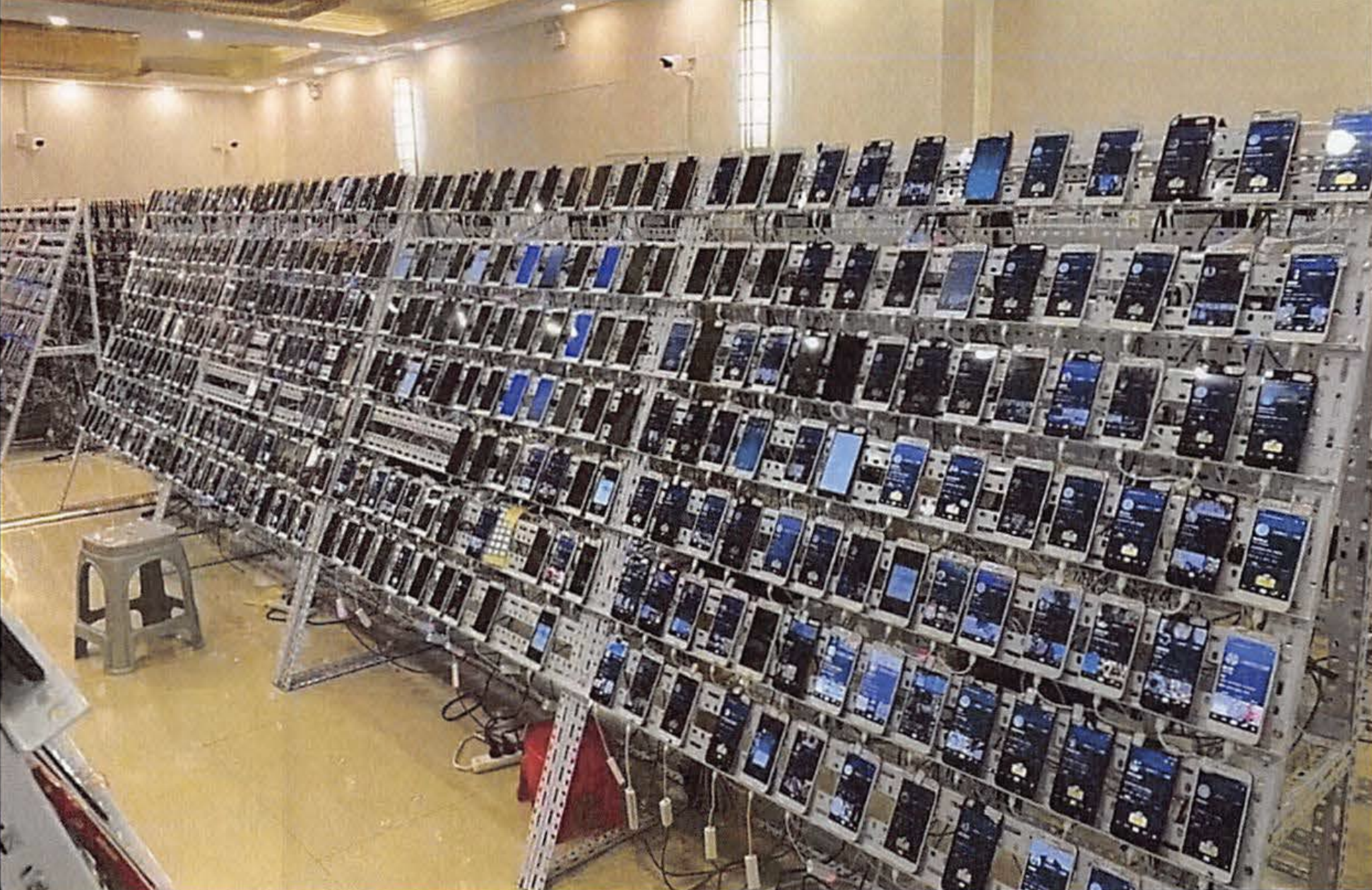
For a cybercrime lawyer or investigator, understanding the boiler‑room model helps explain why your experience matches other victims so closely—and why coordinated, cross‑border enforcement and civil strategies are often necessary to make any dent in the underlying operation.
How Scam Platforms Are Created
To a victim, the trading “platform” often looks polished and professional. However, they tend to follow a few recognizable patterns that betray their fraudulent nature. These similarites can be analyzed and linked across cases.
- Where platform domains are registered. Many pig‑butchering domains are purchased through the same handful of low‑friction registrars (domain sellers that allow quick setup with minimal checks) that support bulk purchases and payment with crypto or prepaid cards. Registrations may cluster in specific jurisdictions or through resellers that have a history of abuse complaints.
- How privacy shields are used. Scammers almost always enable WHOIS privacy or use proxy services—tools that list a third‑party “front” instead of the real owner—so the domain’s public record doesn’t show a person or company. Even so, repeated use of the same privacy provider, contact‑email format, or name‑server combo can help investigators group domains into a single scam network.
- Domain patterns in scammer networks. Domains often reuse the same keywords—“coin,” “bit,” “global,” “capital,” “fx,” “exchange”—with minor variations. When we map dozens of these look‑alike names over time, it’s clear that the same operators are repurposing variations on a theme.
This domain‑level data is a roadmap for blockchain investigators and attorneys: it can connect a victim’s scam platform to an ecosystem of related sites, and strengthen the case that they were targeted by organized crime. If you believe you may have been scammed, see our searchable database of known scam platforms.
Scam Platform Hosting Infrastructure
Scammers host their fake platforms through equally shady providers operating offshore under limited law enforcement supervision. Once a domain is registered, scammers need these providers to host fake dashboards, APIs, and support portals.
- Abuse‑tolerant providers. Many operations favor hosting companies or resellers with a track record of slow abuse response, weak Know‑Your‑Customer (KYC) checks, or opaque corporate structures. We often see the same handful of providers show up across dozens of unrelated‑seeming scam sites.
- Offshore and “bulletproof” behavior. Hosting is frequently placed in jurisdictions with limited cooperation on cybercrime, or routed through “bulletproof” intermediaries (hosts known for ignoring takedown and abuse requests). IP addresses may hop between data centers, but still resolve to the same small set of networks over time.
- Shared infrastructure across sites. Multiple domains in a scam network may share IP ranges, TLS certificates, CDN (content‑delivery) configurations, or backend API endpoints. Mapping these common elements helps identify clusters of related platforms—even when the branding looks completely different.
From a litigation standpoint, this infrastructure map can support targeted preservation letters and takedown requests, and can help show a court that you’re dealing with an organized, repeat‑pattern operation rather than an isolated website.
Where Victims’ Deposits Go
On the surface, the platform shows “trades” and “profits.” On‑chain, the story is simpler: victim funds are consolidated, moved, and laundered through a relatively small set of wallets and services.
- Wallet paths and collection points. Individual deposit addresses usually forward quickly into aggregation wallets—central “collection” wallets controlled by the scammers. Those collection points fan funds out to exchanges, OTC (over‑the‑counter) desks, or other services. Seeing your transaction in the same path as other victims’ deposits is a strong indicator of a shared operation.
- Mixers, tumblers, and swaps. To break traceability, scammers often send assets through mixing services (tools that pool and redistribute crypto to obscure its origin), privacy pools, or rapid token swaps and bridges. While these add noise, they also create recognizable patterns—repeated use of the same mixer contracts, bridges, or timing patterns—that chain‑analysis tools can still follow.
- Liquidity pools and cross‑chain moves. In some cases, stolen funds are parked temporarily in DeFi liquidity pools (on‑chain pools of tokens that others trade against) or moved across chains via bridges to exchanges with weaker controls. Each hop creates additional data points (transaction hashes, pool addresses, timestamps) that a blockchain investigator can document.
For victims with substantial losses, a well‑documented on‑chain flow—showing where funds entered exchanges or other regulated choke points—is often the backbone of any serious crypto asset recovery strategy.
Scam Network Overlaps
Pig‑butchering platforms rarely exist in isolation. The same actors and infrastructure often support multiple scam verticals that share resources and playbooks.
- Romance scams and investment hybrids. Chat scripts, domains, and wallets reused across classic romance scams, “VIP groups,” and trading platforms suggest a single underlying boiler room testing different pitches on different audiences.
- Gambling dApps and high‑yield schemes. Some of the same domains, hosting providers, and wallets appear in fake online casinos, sports‑betting sites, and high‑yield “staking” or “cloud mining” offerings. The surface story changes; the money flows do not.
- Cross‑campaign infrastructure. Shared analytics IDs, CDN configs, or support emails can quietly link what look like unrelated brands into a single scam network.
From a legal perspective, showing that your case is part of a broader pattern can strengthen claims of organized fraud, support joint investigations with other victims, and increase pressure on intermediaries who continued doing business with known bad actors.